Spelling is vital for strong literacy skills.



Did you know?
Only 4% of English words are truly irregular.
Learning about the ‘why’ and ‘how’ through explicit instruction brings spelling to life. The program is designed to be engaging and interactive!
- a range of whole-class and independent activities that help children unravel the mysteries of spelling, with characters such as Stella the Super Speller and Eddy the Editor to help along the way
- detailed lessons with active student participation
- differentiated resources for targeted practice.
Let’s hear from teachers and students about their SpellEx experience.


Phonology, orthography and morphology
When we spell, we rely on our knowledge of phonology, orthography and morphology. Triple Word Form Theory suggests that we integrate these three language components from the very beginning of learning to spell. Rather than focusing on the memorisation of individual words, SpellEx teaches children how to draw on the phonological, orthographic and morphological properties of words.
In the video below, Dr Alison Madelaine explains the SpellEx approach to spelling.

Success with SpellEx
Teaching spelling can be challenging.
SpellEx makes spelling instruction simple for teachers with the lessons and accompanying activities ready to go. Teachers using SpellEx have reported that their own spelling knowledge has significantly improved since delivering the program.
MultiLit’s professional development workshop ensures educators are confident in how to implement the program in their school.
The one-day SpellEx workshop provides an overview of the program, its resources and instructional techniques. Teachers will take away strategies for successfully and effectively delivering the program, whilst gaining an understanding of the research rationale of the spelling approach used in SpellEx.
Training in SpellEx is compulsory prior to implementation of the program to ensure quality of delivery.
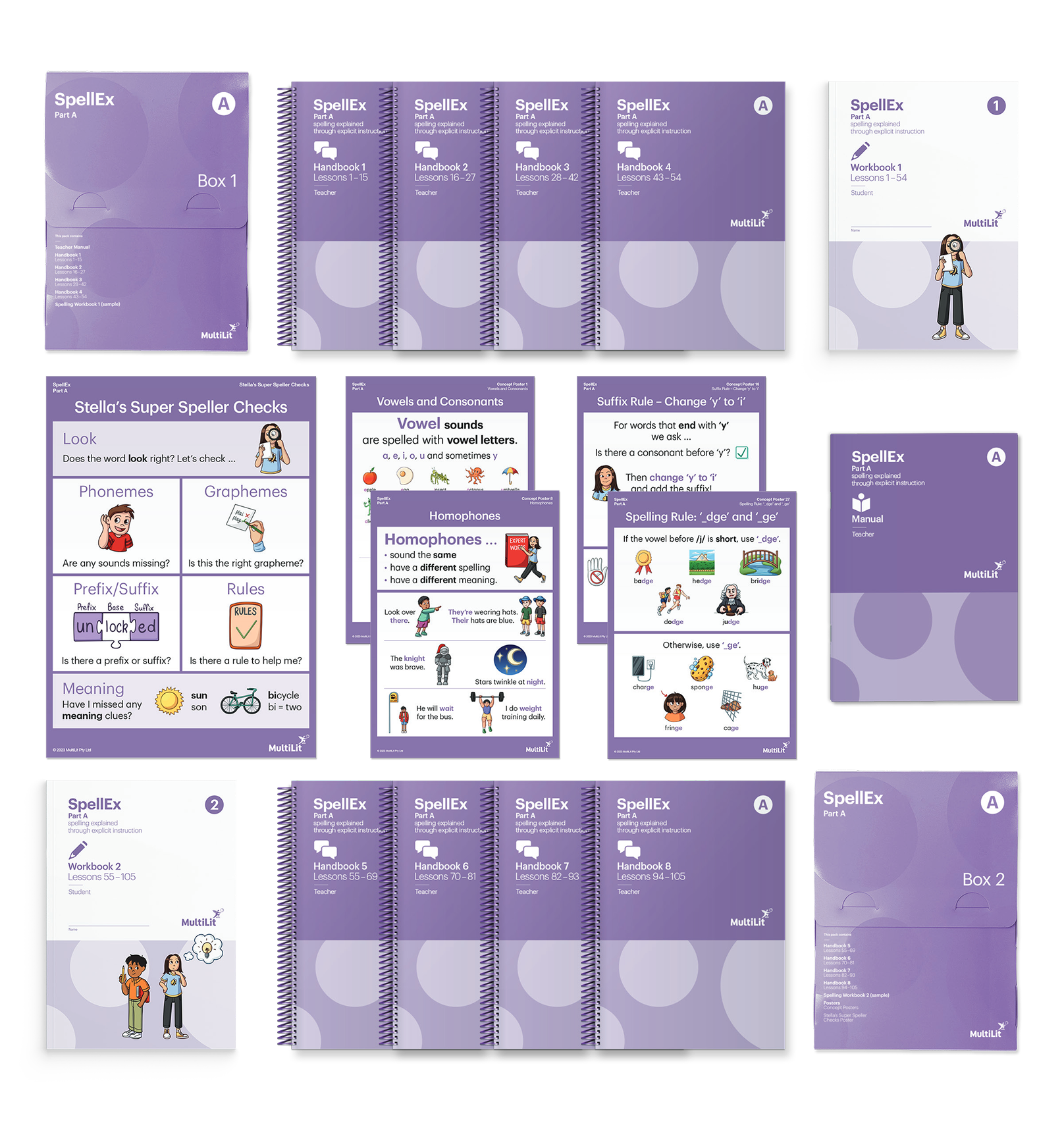
The SpellEx Kit comes with all the materials needed to present whole-class lessons, support and extension mini lessons and the resources to set up additional activities.
The Kit includes a Teacher’s Manual and eight Handbooks with fully scripted lessons.
The Kit also comes with the first set of Student Workbooks to use during the teacher-led lessons as well as for independent practice.
SpellEx provides downloadable resources, available from the Members’ Area of the MultiLit website. These resources include:
- Lesson Presentation slides
- Top-Ups which provide short, sharp revision sessions
- Consolidation worksheets
- Supporting lesson resources (e.g. grab bag words and dictation
sentences, word sort cards, word matrices) - Class Record spreadsheet for recording assessment results.
Differentiation
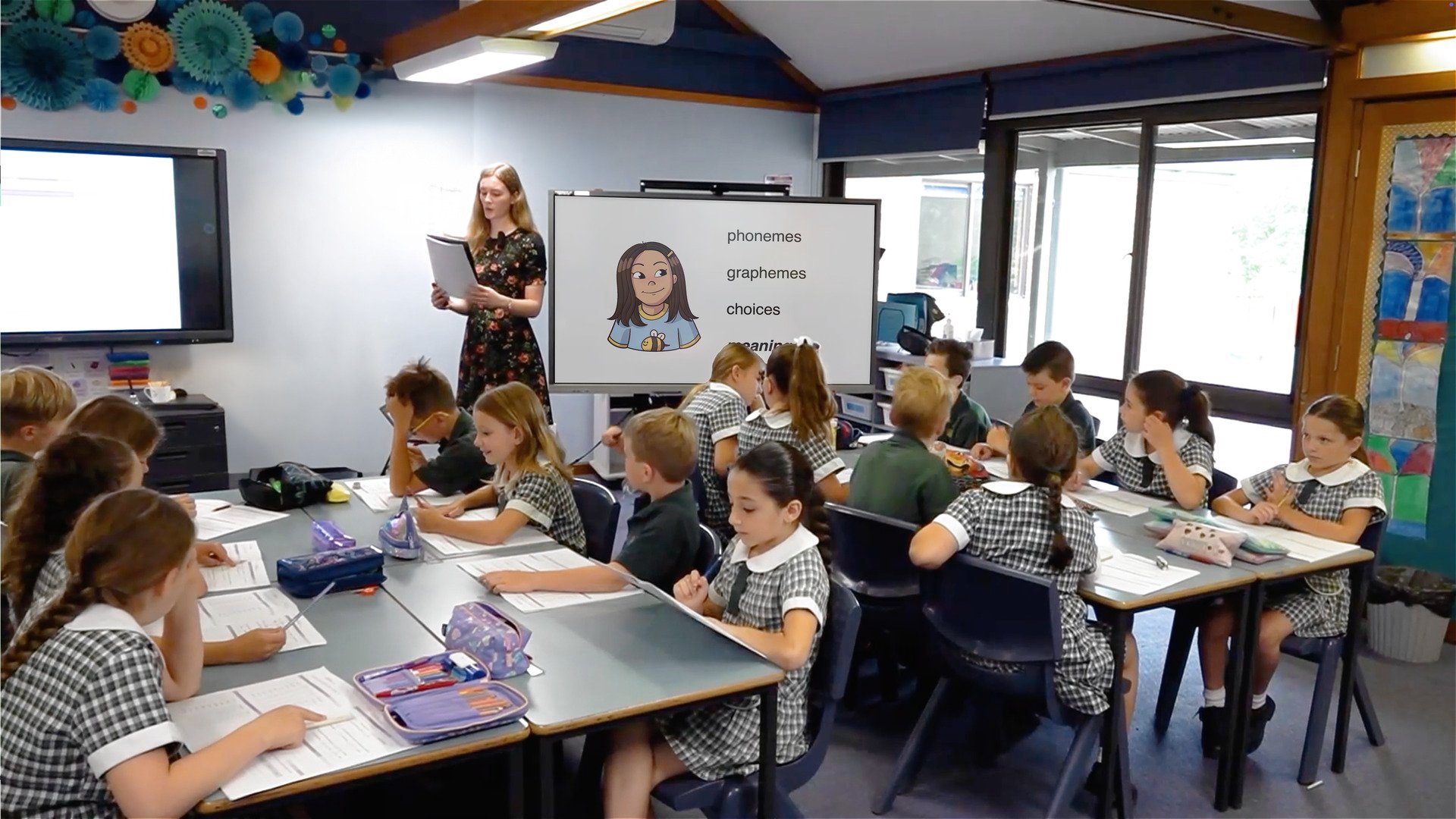
SpellEx is a whole-class program with opportunities for differentiation built in.
Regular Progress Monitoring enables teachers to identify which students need more support and which students may need extending.
Guided by the Progress Monitoring and Cumulative Review data, teachers can revise concepts using Top-Ups or supported practice, and for more capable students, teachers can deliver the extension mini lessons to small groups.
See how SpellEx aligns to the:
- Australian Curriculum v 9.0 here
- NSW Syllabus (Stage 2) here
- Victorian Curriculum v 2.0 here.

Using SpellEx in
Years 5–6
Although SpellEx Parts A and B have been developed for students from Year 3 and 4 respectively, it can also be used in Years 5 and 6 if students have not received explicit instruction in spelling in earlier grades and need to catch up.
SpellEx Part C is currently in development for students from Year 5. Part D will be developed to
follow Part C and will be designed for students in Year 6.
A suggested roadmap for implementation ahead of the release of Part C and Part D is available here.